
I still remember the first time someone asked me how many calories they should be eating. I gave them a textbook answer, something like 2,000 for women and 2,500 for men, and watched their face fall. That number meant nothing to them. It didn’t account for the fact that they walked their dog twice a day, sat at a desk for nine hours, or had just started lifting weights three times a week.
That’s the problem with most calorie advice online. It hands you a number and walks away. The truth is, your calorie needs are personal, and the only real way to know what works for your body is to track it, adjust it, and pay attention to how you actually respond. That’s where a calorie tracker earns its keep. Not as a punishment, but as a mirror that shows you what you’re actually eating versus what you think you’re eating.
So let’s get into it properly. How many calories should you eat a day, what changes that number, and how do you use a calorie tracker to make the whole thing simple instead of stressful.
What Determines How Many Calories You Need
Your calorie needs come down to a handful of things working together: your age, sex, height, current weight, and how active you are day to day. A 25 year old construction worker and a 55 year old office manager are going to need very different amounts of fuel, even if they weigh the same.
Most calculators use something called the Mifflin St Jeor equation to estimate your basal metabolic rate, this is simply the number of calories burned by your body just to keep you alive, before you’ve taken a single step. From there, that number gets multiplied by an activity factor. Someone who is mostly sedentary might only need their BMR plus a small buffer. Someone training five days a week needs quite a bit more.
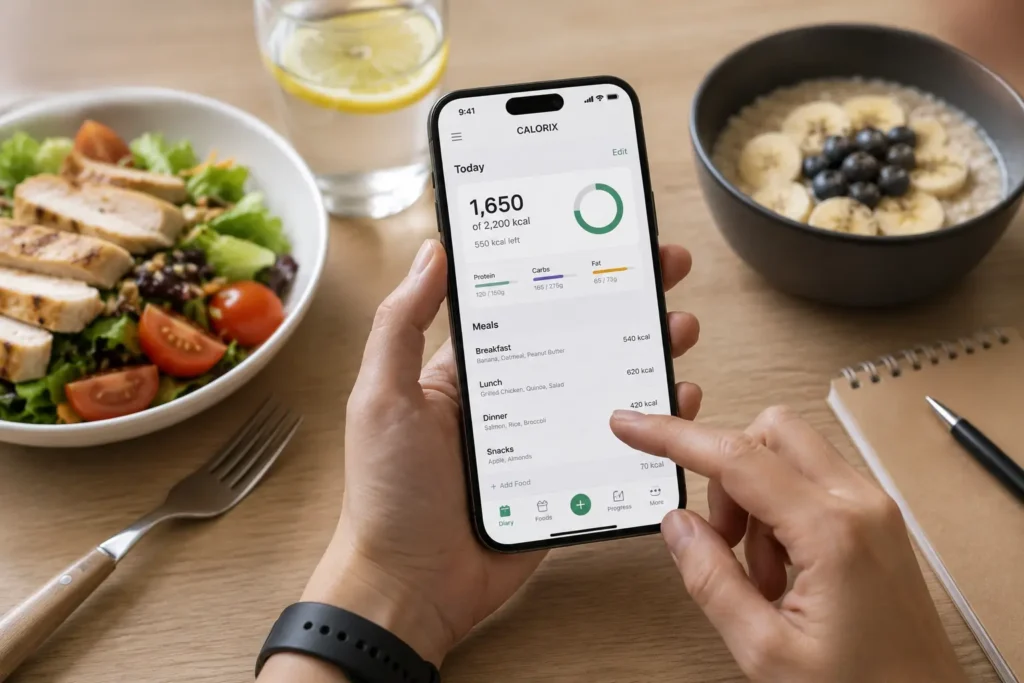
As a rough starting point, many adult women land somewhere between 1,600 and 2,400 calories a day, and many adult men fall between 2,000 and 3,000. But these ranges are wide for a reason. They’re a starting line, not a finish line. The only way to find your actual number is to log what you eat for a couple of weeks using a calorie tracking app, watch what happens to your weight and energy, and adjust from there.
How Many Calories to Build Muscle
If your goal is building muscle rather than losing fat, the math shifts. You generally need to eat slightly above your maintenance level, somewhere around 250 to 500 extra calories a day, paired with enough protein to actually repair and grow the muscle you’re training.
A common target is roughly 1.6 to 2.2 grams of protein per kilogram of body weight, spread across your meals rather than crammed into one sitting. This is where a calorie tracker app becomes genuinely useful, because guessing your protein intake is notoriously difficult. Most people who think they’re eating enough protein are actually falling short by a wide margin, and the only way to know for sure is to log it.
Muscle building is also slow by nature. Eating in a small surplus and training consistently for three to four months, while checking your calorie tracker weekly rather than daily, tends to produce steadier and more honest results than obsessing over every single day.
How Much Weight Can I Lose in a Month
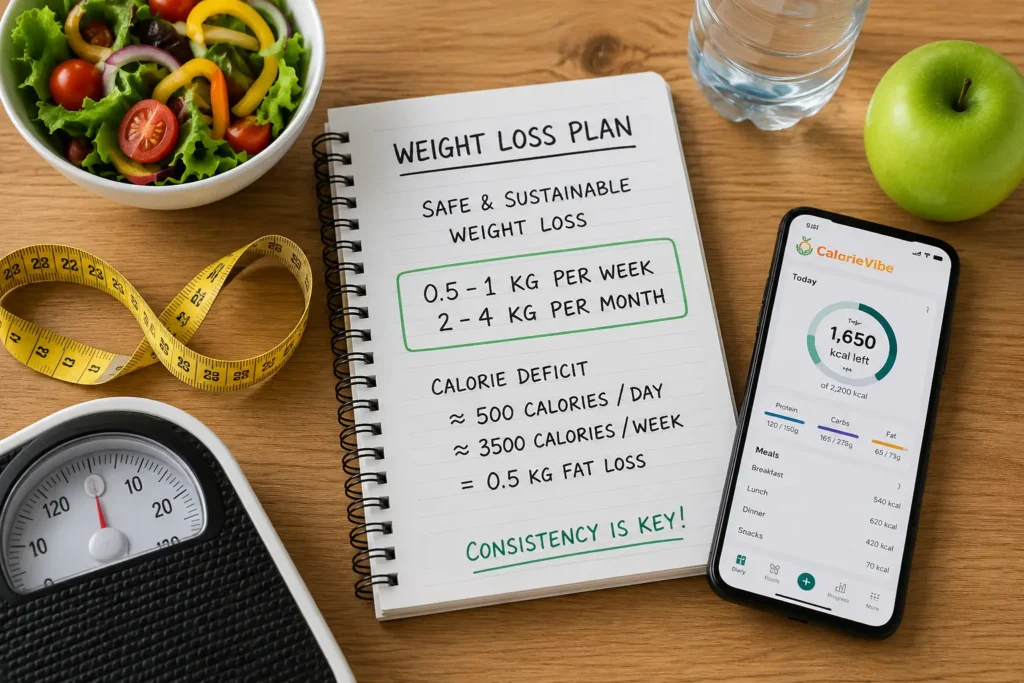
This is one of the most searched questions on the internet, and for good reason. Everyone wants a number they can hold onto. The safe and sustainable range, according to most health bodies including the CDC, is about half a kilo to one kilo per week, which works out to roughly two to four kilos a month.
Losing weight faster than that usually means you’re cutting into muscle, water, and sometimes your patience, rather than just fat. It also tends to backfire, because extreme restriction is hard to sustain and often leads to rebound eating.
The formula behind this is simple in theory. A deficit of about 500 calories a day, seven days a week, produces roughly half a kilo of fat loss per week. But theory and real life rarely match perfectly, which is exactly why tracking matters. Your calorie tracker shows you where the gap is between what you planned to eat and what you actually ate, and that gap is usually where progress quietly stalls.
Should You Use a Calorie Tracker App?
Here’s where I’ll be honest with you. Nobody actually enjoys logging every meal forever. But for the first few weeks of trying to understand your own eating habits, a calorie tracker app is close to essential.
Most people underestimate what they eat by a significant margin, not because they’re lying to themselves on purpose, but because we’re genuinely bad at estimating portion sizes, cooking oils, sauces, and the handful of nuts we grab while making dinner. A calorie tracking app removes the guesswork by putting real numbers in front of you.
A good calorie calculator built into these apps also personalizes your target based on your goal, whether that’s losing fat, building muscle, or simply maintaining where you are. Once you’ve used a tracker consistently for two or three weeks, something interesting tends to happen. You stop needing to log everything obsessively, because you’ve built an internal sense of what a balanced plate actually looks like. The tracker becomes training wheels, not a permanent crutch.
If you’re choosing between apps, look for one with a large, accurate food database, a barcode scanner for packaged foods, and the ability to save your usual meals so logging takes seconds rather than minutes. The friction of using it is often what decides whether you stick with it past week one.
Practical Tips for Managing Your Calories
A few things tend to make the biggest difference once you know your target number.
Protein and fibre keep you fuller for longer, so meals built around lean meat, eggs, legumes, vegetables, and whole grains naturally reduce the urge to snack. Sugary drinks are one of the easiest places to cut calories without feeling deprived, since liquid calories rarely register as satisfying the way food does. Meal prepping a few days ahead removes the decision fatigue that leads to ordering takeout when you’re tired and hungry.
And please don’t chase extremely low numbers hoping for faster results. Cutting too aggressively can lead to nutritional deficiencies, low energy, hair thinning, and a metabolism that slows down to protect itself. If you’re eating under 1,200 calories a day without medical supervision, that’s usually a sign to reassess rather than push harder.
The Real Benefits of Tracking Your Calories
Tracking isn’t about restriction. It’s about information. Once you can see your eating patterns clearly, you start noticing things that used to hide in plain sight, like the fact that your weekday eating is solid but weekends quietly undo the progress, or that you’re barely eating enough protein despite feeling hungry all the time.
A calorie tracker also builds a kind of accountability that willpower alone can’t match. It’s far easier to talk yourself out of a second helping when you can see exactly what it will do to your daily total. Over time, this awareness becomes second nature, and that’s really the goal. Not a lifetime of logging, but a genuine understanding of your own body’s needs.
Why This Approach Works Better Than Guessing
Most diets fail not because people lack willpower, but because they never actually knew their real numbers to begin with. They followed a plan built for someone else’s body and wondered why it didn’t work for theirs. Pairing a calorie calculator with consistent tracking removes that guesswork entirely. You’re no longer following a generic rule, you’re responding to your own data, which is the only approach that holds up over months and years rather than just a few weeks.
Frequently Asked Questions
How many calories are in one chicken breast?
A skinless, boneless chicken breast weighing around 174 grams contains roughly 165 calories, along with about 31 grams of protein, making it one of the most efficient sources of lean protein you can eat.
How many calories are in a strawberry?
A single medium strawberry has around 4 calories. A full cup of sliced strawberries comes to roughly 50 calories, which makes them one of the lowest calorie fruits you can snack on freely.
How many calories are in fruit generally?
Most whole fruits range between 30 and 90 calories per serving, with berries on the lower end and fruits like bananas or grapes sitting higher due to their natural sugar content.
How many calories is 1 kg of body weight?
One kilogram of body fat is estimated to hold about 7,700 calories. This is why a daily deficit of around 500 to 1,000 calories tends to produce roughly half a kilo to one kilo of fat loss per week.
How many calories are in one teaspoon of sugar?
A single teaspoon of granulated sugar contains about 16 calories. It sounds small, but these add up quickly in coffee, tea, and processed foods throughout the day.